










Bulk cables (Type, Speed, Distance)
Bulk Ethernet cables come in a variety of types, speeds, and constructions to meet different network needs. From Category 5E to Category 8, these cables vary in data rates, shielding, jacket ratings, and conductor types, making it important to choose the right cable for each application.
In this post, we’ll break down the differences between cable categories, explain shielded and unshielded options, cover jacket and conductor types, and touch on outdoor and direct burial considerations.
We also offer a full range of these cables in bulk rolls, so you can select the type that fits your project requirements.
Category 5E Cable
Category 5e cable is an enhanced version of Category 5 that adheres to more stringent standards. It can transmit data at speeds of up to 1000 Mbps (1 Gigabit per second) and perform at 100 MHz frequencies. In addition, Category 5E cable improves performance over the old CAT5 standard at up to 10 times faster speeds and reduces cross-talk over distances. CAT5E cables use 24-gauge twisted pair wires to support data transmission at rates up to one Gigabit per second (Gbps) up to 100 meters.
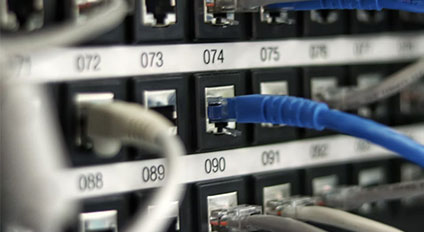
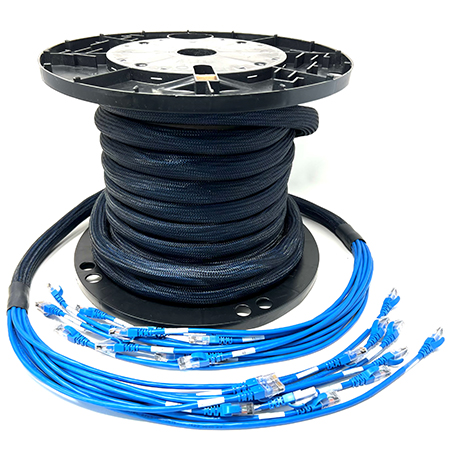
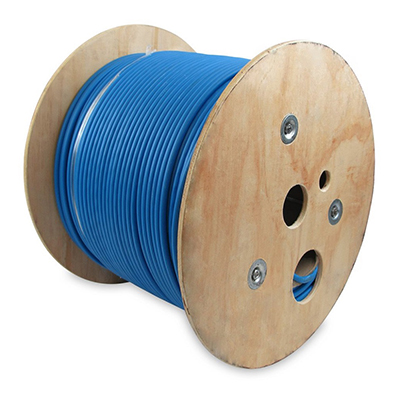
We offer a full spectrum of bulk Ethernet cable, which comes in 1000 foot rolls. Our bulk Ethernet cable includes the following varieties: Category 5E (Enhanced), Category 6, Category 6E (Enhanced), Category 6A (Augmented), Cat 7A, and Cat 8 LAN cable. All category varieties come in Unshielded (UTP) Riser-Rated (CMR) and Plenum Rated (CMP), Shielded (FTP) Riser-Rated (CMR), Shielded (FTP) Plenum Rated (CMP), and Direct Burial Shielded and Unshielded. These varieties are also offered in both Solid Conductor and Stranded Conductor.
Featured Products
Copper cabling types
Category 5E Cable
Category 5e cable is an enhanced version of Category 5 that adheres to more stringent standards. It can transmit data at speeds of up to 1000 Mbps (1 Gigabit per second) and perform at 100 MHz frequencies. In addition, Category 5E cable improves performance over the old CAT5 standard at up to 10 times faster speeds and reduces cross-talk over distances. CAT5E cables use 24-gauge twisted pair wires to support data transmission at rates up to one Gigabit per second (Gbps) up to 100 meters.
Category 6E Cable
Category 6e cable was designed to perform at frequencies up to 250 MHz and offer higher performance for better data transmission at speeds up to 1000 Mbps.
Category 6A Cable
Category 6A cables use twisted-pair cable defined in February 2008 under TIA 568-B standard (568-B.2-10). Category 6A operates at frequencies of up to 500 MHz and can support transmission speeds at 10 Gigabits per second (Gbps).
Category 7A Cable
Category 7A cable is an enhanced cable type designed with increased shielding to improve the frequencies of data speed up to 1000 MHz.
Category 8 Cable
Category 8 cable supports data frequencies up to 2GHz (2000 Mhz) and transmission speeds of Cat8.1 up to 25Gbps and Cat8.2 up to 40Gbps. Furthermore, Category 8 cable supports these data transmission rates within 30 meters. Interference is reduced in Category 8 cable by using shielding with foiled twisted pair (S/FTP) cables to virtually eliminate electromagnetic interference (EMI). Using S/FTP results in fewer errors.
Shielded vs. Unshielded
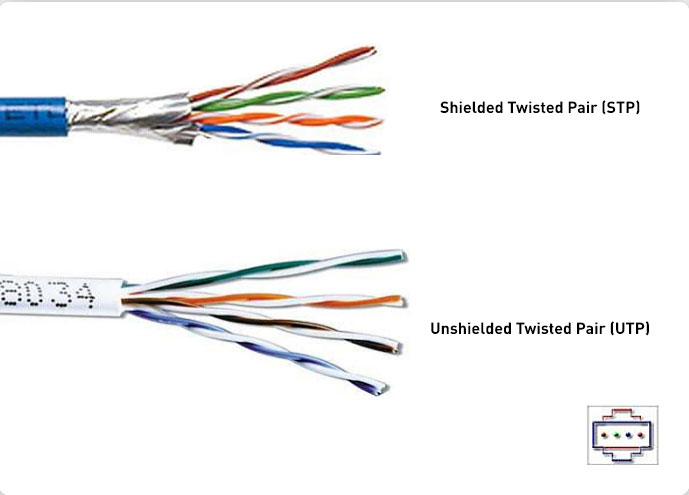
Shielded cables have an outside layer of "shield," made from a conductive material wrapped around the internal conductors. To operate correctly, the shielding is grounded to cancel out the effect of EMI. Interfering signals are conducted or reflected away from the internal conductors to keep them from affecting the carried signals. Shielded cables protect against EMI to increase transmission speeds and reduce data errors.
Unshielded means that no additional shielding, like meshes or aluminum foil, is used inside the cable. Because of this, unshielded Ethernet cables, also called unshielded twisted pair (UTP) cables, are lighter and cheaper. These Ethernet cables are designed to cancel EMI using the pairs of wires are twisted inside the cables. Compared with the shielded cables, unshielded cables provide much less protection. UTP cable performances are often degraded when EMI is present.
Shielded Ethernet cable increases cost more than Ethernet cable that is unshielded, takes up more space when installed in conduit due to its larger diameter, and is less flexible overall. Unshielded Ethernet cable decreases cost more than Ethernet cable that is shielded, provides faster transmission speeds, is less expensive, and installs easier. Always use high-quality cabling regardless of type since better cables equal longer life, and longer cable life reduces costs over time
Unshielded Twisted Pair (UTP)
Unshielded twisted pair (UTP) Ethernet cable is commonly used in local area networks (LANs). UTP Ethernet cable has four pairs of wires surrounded by a jacket. Each twisted pair cancels out noise and interference because they are wound together.
Shielded Twisted Pair (STP)
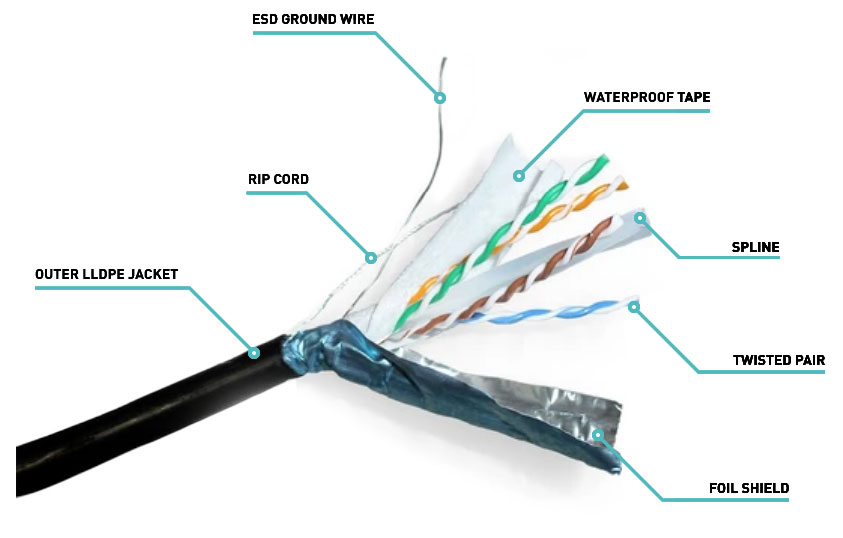
Shielded Twisted Pair (STP) cable contains four twisted pairs wrapped with shielding: a foil wrapping or a copper braided jacket. Shielding of the pairs helps to prevent cross-talk or interference between multiple copper cables that are bundled together.
Foil Twisted Pair (FTP)
Foil Twisted Pair (FTP) is very similar to STP cable, but the difference is that each pair is wrapped in foil shielding to protect the cable from EMI and cross-talk.
Shielded Foil Twisted Pair (S/FTP)
A cable that is considered an S/FTP is a combination of both FTP and STP shielding. First, the wires inside the cable are twisted and then shielded with a foil wrapping, then the 4-pair group of foiled wires is shielded by a wrapping of either foil or flexible braided screening. This provides the highest level of protection from EMI and cross-talk.
Jacket construction (What do these terms mean and when to use plenum-rated)
Communications Multipurpose (CM) cables are rated by the National Electrical Code (NEC) for general use where a fire code does not restrict cable type.
Used in air space above drop ceilings or below raised floors.
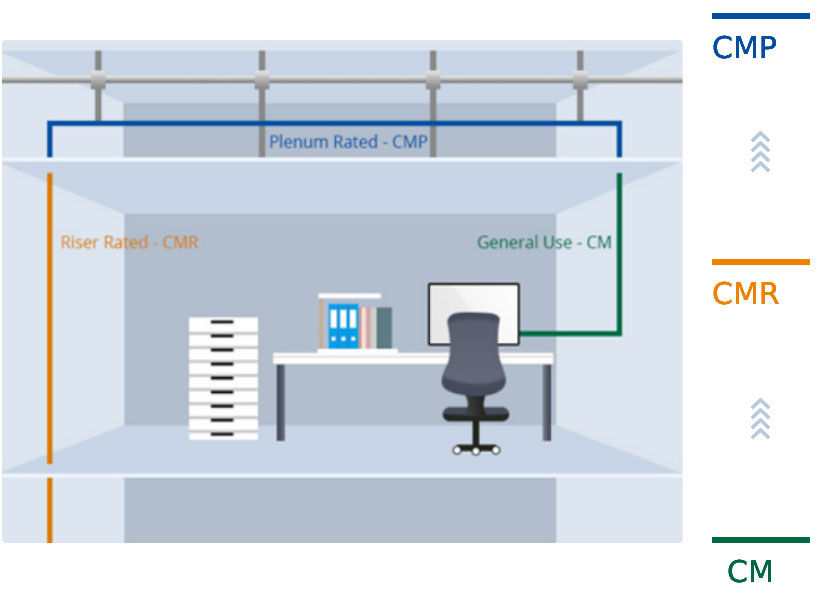
Plenum Rated (CMP)
Communications Multipurpose Cable, Plenum (CMP) cables are constructed to limit smoke and flame propagation. This type of cable runs in air plenums and other environmental airways between the floor and the ceiling. The construction material that makes up these cables is either lowsmoke PVC or fluorinated ethylene polymer (FEP). In addition, CMR cables are certified to prevent flames from traveling more than five feet.
Used in vertical cable chase between floors.
Riser Rated (CMR)
Communications Multipurpose Cable, Riser (CMR) cables are constructed to be fire-resistant. This cable type is used for runs in non-plenum areas such as in elevator shafts and between floors. The construction material that makes up these cables is often polyvinyl chloride (PVC). CMR cables prevent the flame from traveling up the cable a certified number of feet. CMR cables are also designed to be fire-retardant enough to keep the fire from spreading between floors through risers and vertical shafts.
Used in office environment such as desktop cables connection.
Conductor (What do these terms mean and when to use each)
Category 5e (CAT5e) and Category 6 (CAT6) Ethernet cables come with either stranded conductors or solid conductors. One solid wire per conductor is used in a solid conductor, and multiple wires wrapped around each other are used in a stranded conductor.
Solid Conductor
Solid conductor Ethernet cables are used within a building to support structured wiring for inter-building and intra-building cable connections. The solid conductor makes them easy to use with punch-down blocks and patch panels because the wire seats properly when put in place. In addition, solid conductor cables are not designed to flex, bend or twist repeatedly.
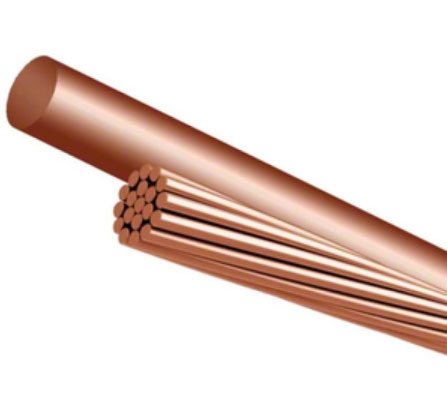
Stranded Conductor
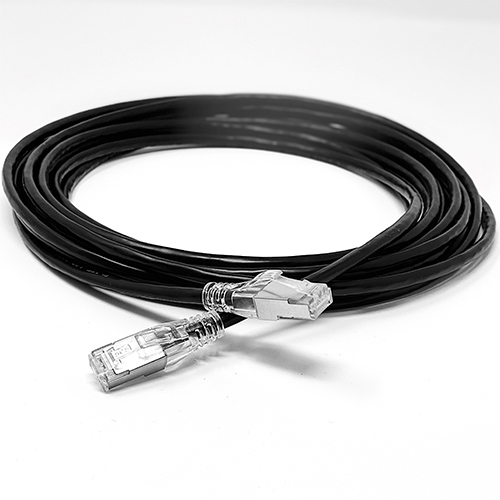
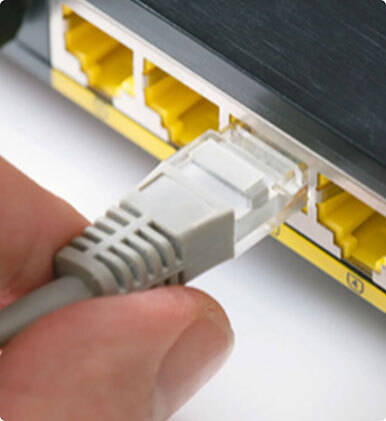
Stranded conductor Ethernet cables are typically used for creating patch cables. Stranded conductor Ethernet cables are designed to flex, bend, and twist repeatedly. Connecting RJ45 terminators with stranded cable results in a complete connection. Stranded conductor Ethernet cables should not be longer than six meters because of the high attenuation. When a stranded conductor Ethernet cable is nicked or scratched, it is less serious because many wires remain to complete the connection.
Outdoor Cable
Outdoor cable is designed for use outdoors and is made from waterproof materials to withstand prolonged cold weather exposure. Outdoor cables are made with durable UV-resistant PVC jackets capable of handling temperatures down to -20 degrees or UV-resistant polyethylene (PE) jackets capable of handling temperatures down to -40 degrees. Outdoor cables are manufactured using the same process as standard cables, so they are not suitable for underground use unless marked for direct burial applications. Outdoor cables also contain internal protection in the form of waterproof tape or gel.
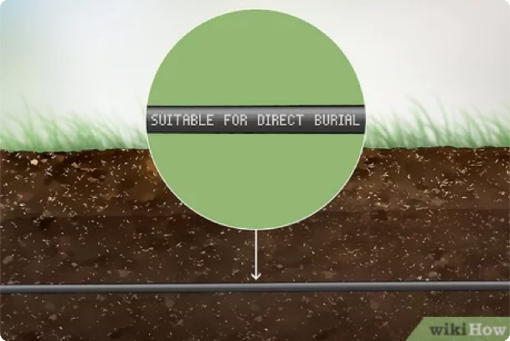
Direct Burial
Direct burial cable is rated for applications where the cable is buried beneath the ground without additional protection or conduit. Direct burial cabling is designed to tolerate conditions present in the ground, including heat, cold, moisture, and other hazards. Choosing direct burial-rated cable helps save time and money in outdoor applications where conduit is necessary or in industrial environments which require extra protection. Although this option is priced higher than standard indoor/outdoor distribution cable that needs to be run inside the conduit, it outweighs its overall price compared to the cost of purchasing the conduit and then having to pull the cable through it. Direct burial cables can also be ordered with additional protection, such as a stiff interior spline to prevent crushing or armor that stops rodents from biting through the cable.
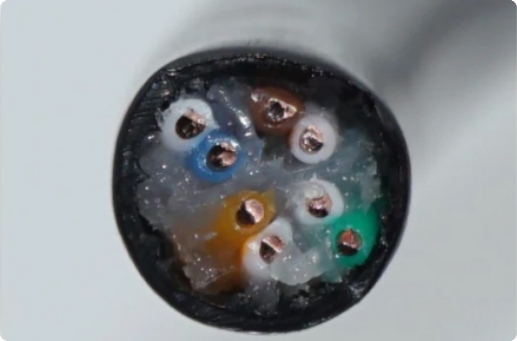
Gel-filled
Gel-filled cables ensure water or moisture does not damage the wires inside a cable because of the water-blocking agents or gel inside the tube. The gel filling prevents water ingress by filling the space in a tube to block the flow and entrance of water. The gel also allows the conductors to remain free-floating, reducing wire tension. Gel leaks from the tube if the tube is cut, making repair and maintenance more difficult. The gel is safe for the environment and does not harm the skin.