










Introduction
As enterprise networks continue to scale, network teams are often faced with a practical decision: how far can copper cabling still take us?
Despite the rapid growth of fiber deployments, Cat 6A Ethernet cables remain a reliable and widely used option for 10 gigabit networking across enterprise buildings, data centers, and high density access networks. In many upgrade projects, installers turn to Cat 6A when existing Cat 5e or Cat 6 infrastructure can no longer support growing device density, higher PoE loads, or future bandwidth planning.
This article explains what Cat 6A Ethernet cables are, how they work, where they are used, and how to choose the right one - based on real deployment considerations rather than marketing claims.
What Is a Cat 6A Ethernet Cable?
Cat 6A, short for Category 6 Augmented, is a twisted pair copper Ethernet cabling standard defined by TIA 568 and ISO/IEC 11801. It is designed to support 10 Gigabit Ethernet (10GBASE T) at distances of up to 100 meters. Cat 6A was introduced to overcome limitations found in earlier categories, particularly alien crosstalk, which became a major issue as data rates increased and cable bundles became more common in real installations.
Key characteristics of Cat 6A cables include:
- Bandwidth support up to 500 MHz.
- Full distance 10GbE performance.
- Improved pair separation and shielding options.
- Better resistance to external electromagnetic interference.
Field Insight: In performance-critical pathways, alien crosstalk typically becomes noticeable long before installers expect it. Cat 6A construction was specifically engineered to maintain performance when cables are bundled in ceilings, trays, and racks; however, its larger diameter must be planned for to ensure it doesn't conflict with space constraints.
How Cat 6A Ethernet Cables Work
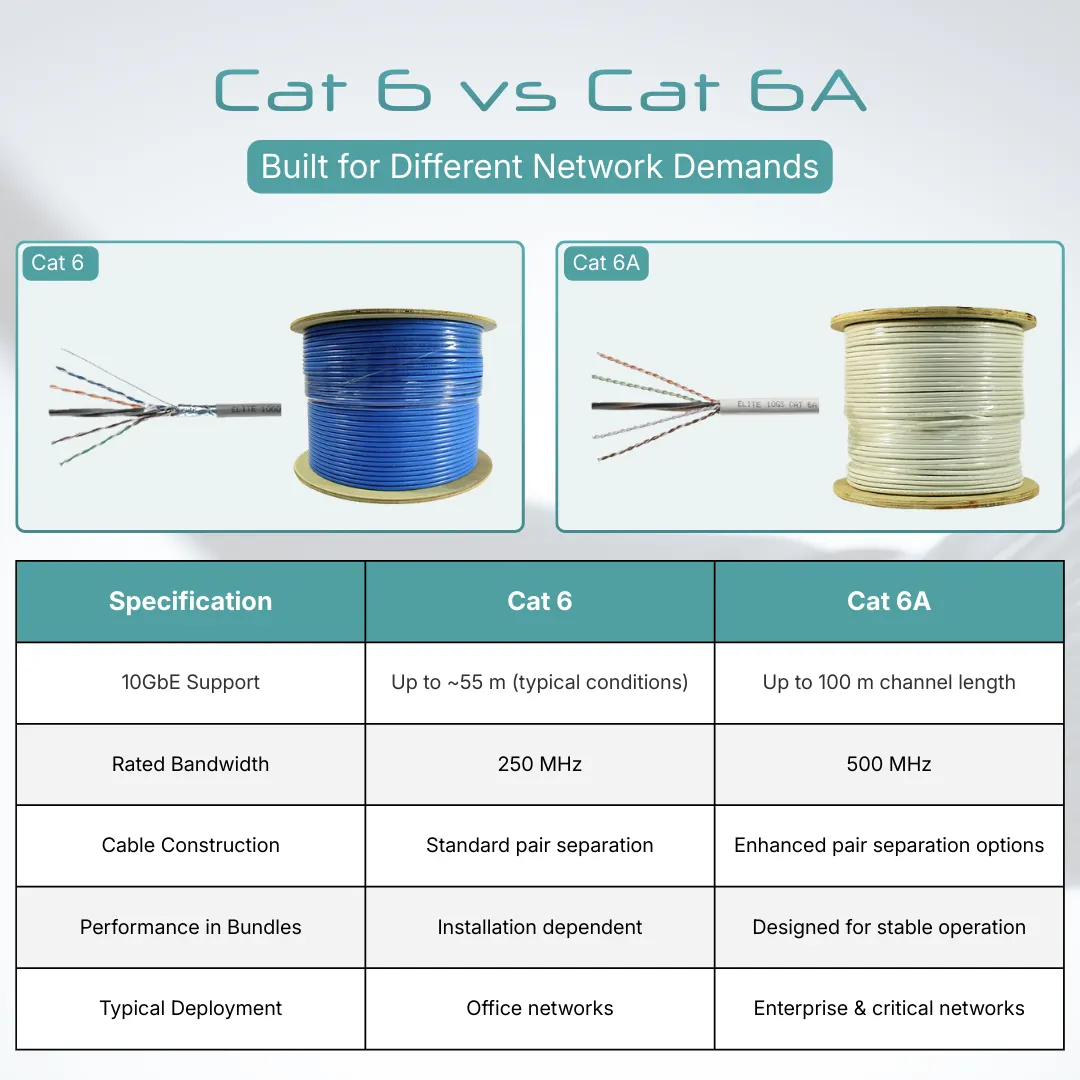
Cat 6A cables transmit data using four balanced twisted copper pairs. Twisting reduces electromagnetic interference, while Cat 6A construction adds additional separation and shielding to preserve signal integrity at higher frequencies. Performance improvements are primarily achieved by reducing near-end crosstalk and alien crosstalk from adjacent cables.
These characteristics become critical in real-world installations where large cable bundles are routed through ceilings, pathways, and racks. In practice, installers often notice performance differences not during testing, but after network expansion increases cable density. Specifically, when shielded, Cat 6A helps significantly reduce alien crosstalk compared to Cat 6, maintaining stability as environments scale provided the infrastructure can accommodate the larger physical diameter of the cabling.
Cat 6A vs Other Ethernet Cable Categories
Cat 6A vs Cat 6
Cat 6 can support 10 gigabit Ethernet only at reduced distances, typically up to 55 meters under controlled conditions. Cat 6A supports 10GbE across the full 100 meter channel length defined by Ethernet standards.
For many upgrade projects, choosing Cat 6A avoids the risk of re cabling later when bandwidth or PoE demands increase.
Cat 6A vs Cat 7 and Cat 8
Higher categories such as Cat 7 and Cat 8 offer increased theoretical performance but introduce higher cost, limited connector ecosystems, and narrower use cases.
For most enterprise and commercial networks, Cat 6A delivers the most practical balance between performance, compatibility, and cost - especially where standardized RJ45 connectivity remains important.
Shielded vs Unshielded Cat 6A Cables
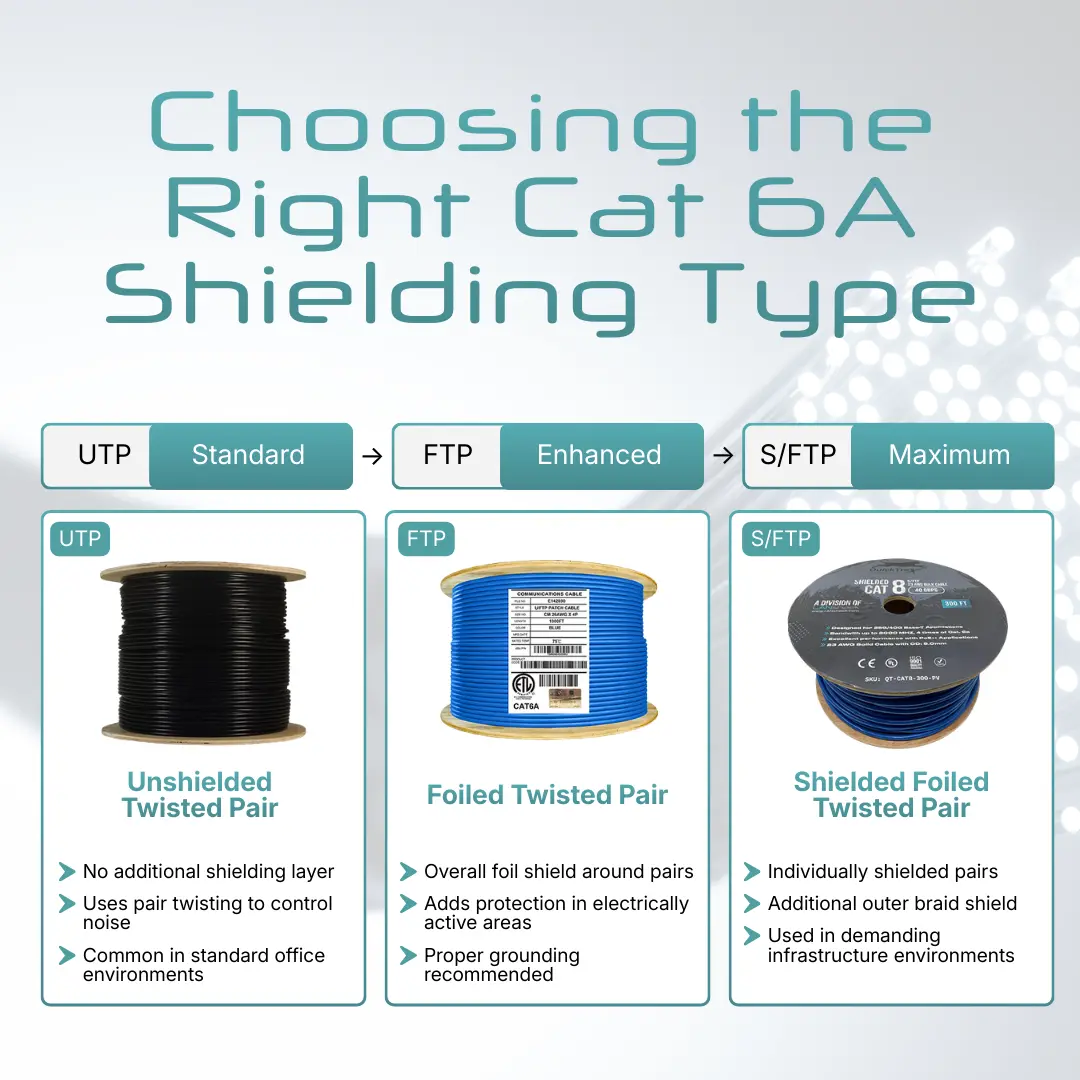
Cat 6A cables are manufactured in several constructions including UTP, FTP or STP, and S/FTP.
Shielded Cat 6A is commonly deployed in environments with elevated electromagnetic interference such as data centers, industrial facilities, and healthcare buildings.
Proper grounding is essential when using shielded cables. Inadequate grounding can reduce performance or introduce noise - a common issue seen when shielding is added without proper system planning.
Installer Tip: Shielding is most effective when the entire channel is designed correctly. Mixing shielded and unshielded components often creates more problems than it solves.
Where Cat 6A Ethernet Cables Are Used
Cat 6A is widely used in enterprise access and distribution networks, data center copper interconnects, industrial environments, and Power over Ethernet deployments. It is particularly effective in applications that require both high data throughput and reliable power delivery. Many structured cabling projects adopt Cat 6A specifically to support modern wireless access points, surveillance systems, and high-power PoE devices within critical networks requiring high performance.
Common Deployment Scenarios
How to Choose the Right Cat 6A Ethernet Cable
Selecting Cat 6A involves more than choosing a category label. Performance depends heavily on environmental and installation factors.
Key considerations include installation environment, EMI exposure, cable routing density, shielding requirements, fire ratings, and third party testing.
Real World Consideration: Cable diameter and pathway capacity are frequently overlooked during planning. Cat 6A cables are larger than earlier categories, and conduit or tray space should be evaluated early to avoid costly rework.

In enterprise deployments, selecting Cat 6A involves more than simply meeting 10-gigabit performance requirements. Real-world considerations like alien crosstalk mitigation, cable diameter and pathway fill, shielding strategy (UTP vs. F/UTP), and heat buildup from high-power PoE loads all impact long-term reliability. Careful specification and installation planning upfront help ensure consistent performance, compliance with TIA standards, and reduced risk of costly rework as bandwidth demands continue to grow.
Tom Damiano
Installation Best Practices for Cat 6A Cables
Due to their larger diameter and shielding options, Cat 6A cables require careful handling during installation.
Best practices include maintaining bend radius, avoiding excessive pulling tension, separating data from power cables, using compliant connectors, and certifying links after installation.
Installers frequently encounter performance issues caused by termination quality rather than cable limitations. Proper training and testing remain critical for achieving expected 10GbE performance.
Proper termination plays a critical role in Cat 6A performance. The following video demonstrates best-practice installation of shielded modular plugs using a loadbar system.
Common Issues with Cat 6A Ethernet Cables
Most Cat 6A issues result from installation errors rather than cable limitations. Common challenges include alien crosstalk, grounding mistakes, termination issues, and space constraints.
In many troubleshooting cases, resolving pathway congestion or correcting termination practices restores expected performance without replacing the cable itself.
Cat 6A and Power over Ethernet (PoE)
Cat 6A performs reliably in PoE, PoE+, and PoE++ environments due to its lower DC resistance and improved thermal stability in bundled installations. As PoE power levels increase under IEEE 802.3at and 802.3bt standards, heat buildup inside dense cable pathways becomes a real-world design consideration. Cat 6A’s larger conductors and enhanced pair separation help manage temperature rise more effectively than lower-category cables, supporting stable data transmission and consistent power delivery across the full 100-meter channel length.This advantage is reflected in practical deployment feedback, where installers often prioritize termination quality and dependable power pass-through. As one customer review notes, the panel was “easy to terminate and passes POE at CAT6 with no issues,” reinforcing a key field reality: in higher-power PoE applications, cable construction and installation integrity directly influence long-term network reliability.

Future Outlook for Cat 6A Ethernet Cables
While fiber dominates long distance connectivity, Cat 6A remains relevant where copper simplicity, standardized connectors, and power delivery are required.
Rather than replacing each other, fiber and copper increasingly serve complementary roles within modern network architecture.
Frequently Asked Questions
Q1: Does Cat 6A support 10GbE at full 100 meters?
Yes, Cat 6A is designed for full-distance 10GBASE-T performance under standard channel conditions.
Q2: Is Cat 6A required for PoE++ installations?
Not mandatory, but strongly recommended due to improved heat dissipation and lower resistance in bundled cables.
Q3: What is the difference between UTP and shielded Cat 6A?
Shielded versions reduce EMI in electrically noisy environments but require proper grounding to perform correctly.
Q4: Can Cat 6A use standard RJ45 connectors?
Yes. Cat 6A maintains backward compatibility with RJ45, unlike higher categories such as Cat 7.
Q5: When should fiber be used instead of Cat 6A?
Fiber is preferred for backbone links, long distances, and environments requiring higher bandwidth scalability.
Q6: Is Cat 6A harder to install than Cat 6?
Yes. Larger diameter and stiffness require more pathway planning and careful termination.
Q7: What causes most Cat 6A performance failures?
Installation issues such as poor termination, improper grounding, or excessive cable bundling.