










Introduction
In today's digital landscape, fiber networks have emerged as the premier solution for high-speed and reliable connectivity essential for businesses, data centers, and telecommunication networks. A critical decision faced by installers, engineers, and procurement officials involves selecting between pre-terminated and field-terminated fiber optic solutions. This choice significantly impacts network performance, reliability, and overall deployment costs.
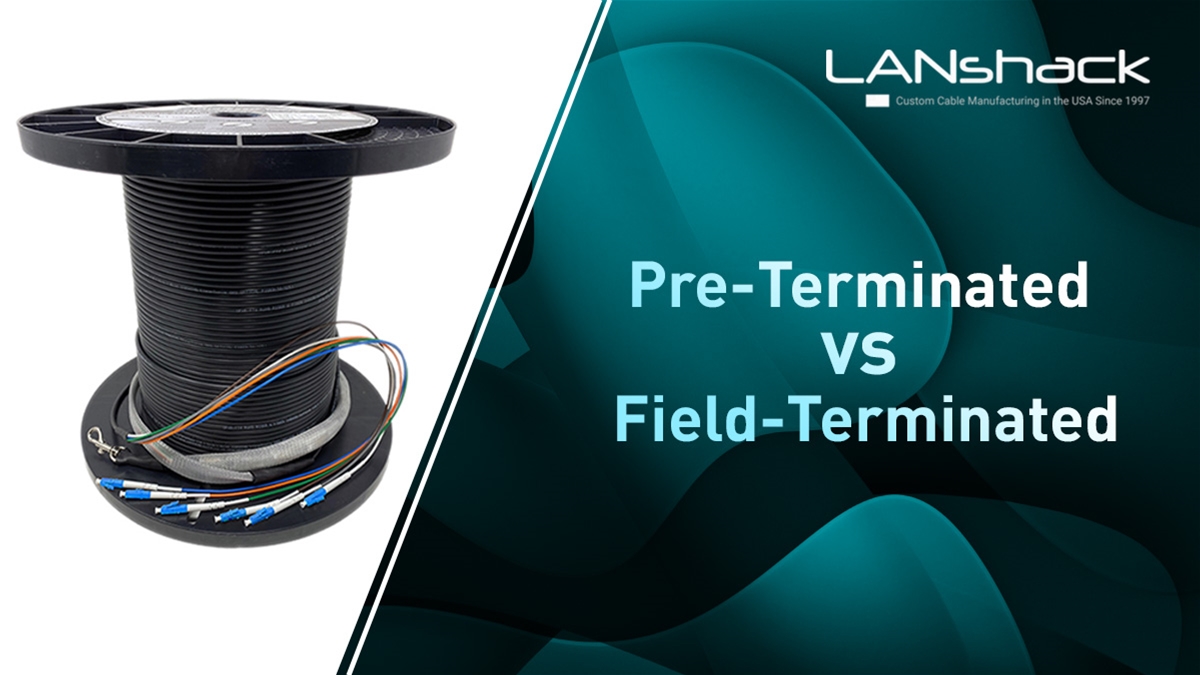
Pre-terminated fiber assemblies are pre-fabricated, factory-tested, and designed for quick, plug-and-play installation, thereby minimizing on-site labor and the potential for rework. Conversely, field termination provides the flexibility to create custom cable lengths and make on-site adjustments, but it can lead to increased variability, extended installation times, and quality inconsistencies.
This guide comprehensively compares both approaches within real-world contexts, including data centers, enterprise environments, and industrial networks. It emphasizes the advantages of factory pre-termination in simplifying installation processes, enhancing consistency, and ensuring long-term optical performance in demanding fiber optic deployments.
Challenges with Field Termination
Field termination is frequently selected for its inherent flexibility and adaptability in on-site applications.
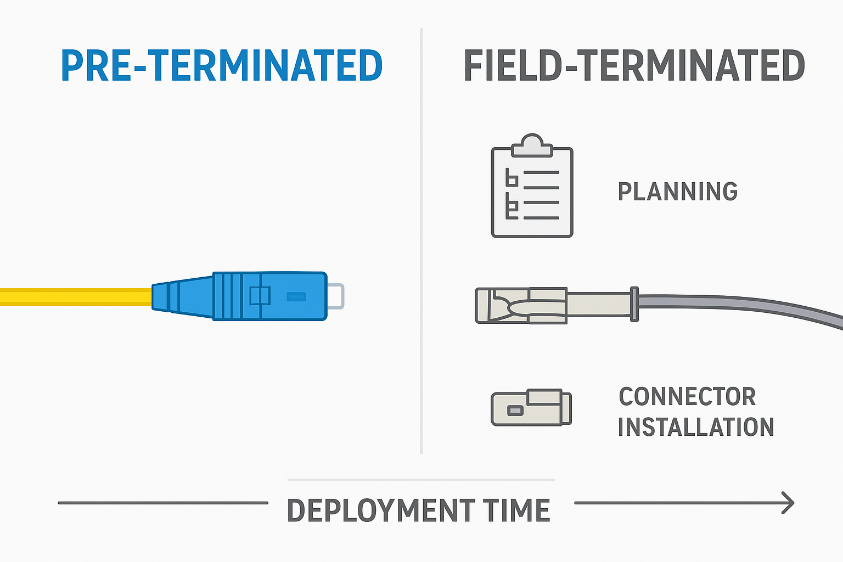
However, it also presents several technical and operational challenges that can significantly impact network reliability and performance. The quality of field-terminated connections is contingent upon the skill level of the installer, environmental conditions, and the precision of the tools utilized. These factors can make achieving consistency particularly challenging, especially in large-scale or time-sensitive projects.
Key Challenges
- Variability: The performance of field-terminated connections can vary from one connector to another due to human error, environmental dust, or humidity. Inconsistent polishing and alignment often lead to increased insertion loss and reflection, reducing overall network efficiency.
- Time-Intensive Process: Each termination involves multiple steps including stripping, cleaving, polishing, and testing which can prolong installation times and escalate labor costs. This time-consuming process can hinder project timelines.
- Rework and Quality Issues: Field-made connectors may not achieve the precision of factory-terminated solutions. Minor errors during the termination process can necessitate re-termination, resulting in delays and material waste.
- Limited Testing Capabilities: On-site testing tools frequently lack the accuracy of laboratory-grade equipment, making it challenging to verify consistent optical performance. This limitation can lead to undetected issues that compromise network integrity.
Solution: How Factory Pre-Termination Simplifies Installation and Ensures Reliability
1. Simplifying Installation Through Plug-and-Play Design
Factory pre-terminated fiber assemblies simplify installation by eliminating the complex, error-prone steps required in field termination. Each cable is assembled, polished, and tested in a controlled ISO 9001–certified environment, ensuring low insertion loss (IL) and return loss (RL) before reaching the job site. This approach removes the need for on-site stripping, cleaving, polishing, and testing operations often affected by dust, temperature, or limited workspace.
2. Reducing On-Site Labor and Installation Time
With connectors pre-installed and factory-verified, installers can simply route and plug in the assemblies. This plug-and-play design cuts installation time by up to 40–60%, reduces labor dependency, and minimizes the need for specialized tools. The result is faster project delivery, consistent performance, and reduced risk of rework or contamination.
3. Ensuring Consistent Quality and Long-Term Reliability
From a reliability perspective, factory pre-termination ensures uniform quality, mechanical precision, and long-term signal integrity across all links. Each assembly undergoes stringent factory tests to confirm optical performance and durability, helping prevent degradation and costly maintenance in the field.
4. Configurations for Every Environment
Pre-terminated fiber assemblies are available in a wide range of configurations including indoor/outdoor, armored, micro-armor and hybrid, and MPO/MTP high-density options designed to meet the unique requirements of data centers, enterprise networks, and industrial facilities.
5. Single Mode Assemblies
Pre-terminated Single Mode fiber assemblies are designed for long-distance, high-speed transmission with exceptional optical clarity. Equipped with LC, SC, FC (UPC/APC), or ST (UPC) connectors, and available in strand counts up to 288 fibers. They support network scalability and performance consistency across telecom, metro, and backbone infrastructures.
Typical Performance Specifications:
- Insertion Loss (IL): Max 0.2 dB, Min –0.1 dB
- Optical Return Loss (ORL): –55 dB
- Supported Speeds: 1 Gbps – 400 Gbps
- Distance: Up to 100 km with minimal signal loss
6. Multimode Assemblies
Multimode fiber assemblies (OM1, OM2, OM3, OM4, OM5) are ideal for short-to-medium-distance, high-bandwidth applications. Available with LC, SC, FC (UPC/APC), and ST (UPC) connectors, and supporting strand counts up to 144 fibers, they deliver scalable, low-loss connectivity for LANs, data centers, and enterprise networks.
Typical Performance Specifications:
- Insertion Loss (IL) for 62.5/125 µm and 50/125 µm: Max 0.2 dB, Min –0.1 dB
Factory testing validates each assembly’s compliance with performance standards, ensuring consistent optical results and trouble-free installation in any environment.

In real projects, the challenge with field termination isn’t the technology itself, it’s the unpredictable human and environmental factors, the true ‘uncontrolled variables.’ By shifting to pre-terminated solutions, we move from managing risks in the field to guaranteeing results before the first cable is even installed. The outcome is certified, consistent optical performance straight out of the package, every single time.
Tom Damiano
Fiber Optic Specialist
Key Differences: Pre-Terminated vs Field-Terminated Fibre
|
Features |
Pre-Terminated Fiber |
Field-Terminated Fiber |
|
Installation Time |
Very fast — plug-and-play setup, minimal preparation |
Slower — requires on-site stripping, cleaving, polishing, or splicing |
|
Skill Level Required |
Low — minimal training needed |
High — requires experienced fiber technicians |
|
Performance Consistency |
Factory-tested for low loss and high reliability |
Dependent on installer skill and field conditions |
|
Equipment Needed |
No special tools or splicing equipment required |
Requires fusion splicer, cleaver, polishing kits, and test gear |
|
Quality Control |
Tested and certified under factory conditions |
Quality varies with environment and workmanship |
|
Cost (Initial/Overall) |
Slightly higher material cost but lower labor cost |
Lower material cost but higher labor and equipment cost |
|
Flexibility On-site |
Limited — fixed lengths and connector types |
High — can customize cable length and termination in the field |
|
Maintenance and Upgrades |
Simple plug-and-play replacement or expansion |
More complex — requires field termination or splicing again |
|
Continuous uptime and secure compliance |
OTDR Testing & Real-Time Monitoring |
Proactive fault detection, compliance documentation |
|
Cleanliness & Safety |
Cleaner — no bare fiber handling |
Greater risk of contamination or fiber shards |
|
Typical Applications |
Data centers, structured cabling, FTTx, modular networks |
Outdoor installations, custom-length links, repairs, or retrofits |
Proof in Practice
The following scenarios illustrate how pre-terminated fiber solutions perform across varied deployment environments, delivering superior speed, consistency, and reliability compared to field-terminated methods.
1. Data Center Deployment
In high-density data centers, Single Mode and Multimode (OM3, OM4, OM5) assemblies cut installation time by up to 40%. Factory-tested connectors with insertion loss below 0.35 dB ensure low attenuation and optimal signal integrity. Each assembly is clearly labeled for plug-and-play use, enabling rapid deployment and minimal rework.
2. Enterprise Campus Upgrade
For multi-building or extended-reach applications, Single Mode solutions provide exceptional bandwidth and distance. Multimode OM4 and OM5 cables support high-speed internal runs, reducing on-site termination time and maintaining optical consistency across all links.
3. Industrial Fiber Backbone

In demanding environments where dust, vibration, and temperature variations are common, pre-terminated Single Mode and OM2/OM3 Multimode assemblies offer factory-sealed protection. Their ruggedized design ensures long-term signal stability, minimizes maintenance, and supports continuous, mission-critical operation.
Together, these examples demonstrate how pre-terminated assemblies deliver measurable performance, efficiency, and reliability advantages across every industry setting.
Conclusion
For installers, engineers, and procurement professionals, choosing pre-terminated fiber assemblies ensures faster deployment, higher reliability, and long-term efficiency. While field termination allows customization, factory pre-terminated solutions offer precision, reduced installation time, and eliminate on-site errors.
Their plug-and-play design minimizes labor and tool requirements, while factory-tested quality guarantees consistent performance and fewer maintenance issues. By selecting the appropriate jacket type and strand count for your environment, teams can achieve optimal network performance. For scalable, future-ready infrastructure, pre-terminated fiber assemblies remain the most reliable and cost-effective choice for modern public and private network deployments.
Explore pre-terminated fiber assemblies engineered and tested for reliable, fast, and consistent real-world performance.
Frequently Ask Questions (FAQs)
Q1: What’s the main performance difference between pre-terminated and field-terminated fiber?
Pre-terminated cables, such as assemblies, are manufactured and polished in a controlled factory environment. This ensures consistent alignment, low insertion loss (IL), and low return loss (RL). Field-terminated fiber, by contrast, depends on the installer’s skill and field conditions, which can lead to performance variability and higher signal loss.
Q2: How much time can pre-terminated cables save?
Using pre-terminated fiber can reduce installation time by up to 40–60% compared to field termination. Since connectors are pre-polished and tested, installers can simply route and plug in the cables no splicing, curing, or polishing required. This translates into faster project completion and reduced labor costs.
Q3: What’s an acceptable insertion loss for reliable connections?
For most data center and enterprise applications, insertion loss below 0.5 dB per connector is considered reliable. pre-terminated assemblies typically achieve less than 0.35 dB, ensuring optimal signal transmission and higher network reliability across all connections.
Q4: How are pre-terminated cables tested before shipping?
Every cable assembly undergoes 100% factory testing for insertion loss, return loss, and continuity. These tests are performed using calibrated equipment in an ISO 9001 certified facility. Test results are documented and included with each shipment, guaranteeing verified performance before installation.
Q5: Can field termination meet Data Center standards?
While field termination can work for smaller projects, it rarely meets the precision and repeatability required for Data Center or high-density environments. Factors like dust, humidity, and tool condition can affect end-face quality. pre-terminated fiber ensures factory-level consistency that aligns with Tier 3 and Tier 4 Data Center standards.
Q6: What factors determine whether to choose pre-term or field-term?
Choose pre-terminated fiber when speed, reliability, and performance consistency are top priorities especially in data centers, enterprise networks, and structured cabling. Field termination may suit smaller, one-off installations with frequent length changes. For most professional deployments, pre-terminated solutions provide a faster, cleaner, and more predictable outcome.