










The U.S. now has more than 72 million fiber broadband subscriptions, reflecting continued growth in high-speed internet adoption, according to the Organization for Economic Cooperation and Development (OECD). Investment in fiber infrastructure also remains strong. In 2024 alone, fiber broadband spending in the U.S. is projected to exceed $1.5 billion, driven by surging demand across enterprise and residential markets, based on recent data from Statista.
This momentum highlights a marketplace defined by constant innovation, where fiber solutions evolve to meet rising performance expectations. For businesses aiming to upgrade their network infrastructure, the fiber landscape is rich with advanced technologies. Two standout innovations gaining traction are OM5 multimode fiber and wavelength-division multiplexing (WDM). IT leaders planning new fiber deployments should examine these technologies closely to determine how they might enhance network speed, efficiency, and scalability.
Featured Products
Understanding the rise of OM5
OM5 cables are receiving considerable attention in the networking arena - and for good reason. Conventional multimode fiber optic cabling has reached its operational threshold in the age of the Internet of Things. Existing solutions cannot support current transmission speeds of between 10 and 25 gigabytes per second. With broadband speeds poised to dwarf these figures over the years to come, the current multimode fiber products on the market are simply not fit to support networking installations of the future. This is where OM5 cables come into play.
These fixtures are part of the newly established wideband multimode fiber family. Consequently, OM5 fiber can facilitate the fast-moving data that circulates high-bandwidth infrastructure, including modern wireless assets and the device management systems that support them.
How? The cable taps into additional wavelengths to bolster the transmission power of each fiber strand by a factor of four. This, in turn, drastically increases data rates, giving OM5 cabling the power to support next-generation devices and infrastructure.
The rise of OM5 is a significant development for modern enterprises, many of which are in the process of developing and deploying data-centric workflows centered on the latest connected technology. For instance, more than 4 billion enterprise IoT assets will have service by the end of the year, according to analysts at Gartner. That figure will increase to more than 7 billion by 2020. As the adoption of high-bandwidth IT infrastructure continues, organizations will need to reassess their cabling solutions and search for advanced products that can handle the ever-rising information load. OM5 cabling technology is the ideal option.
Grappling with WDM
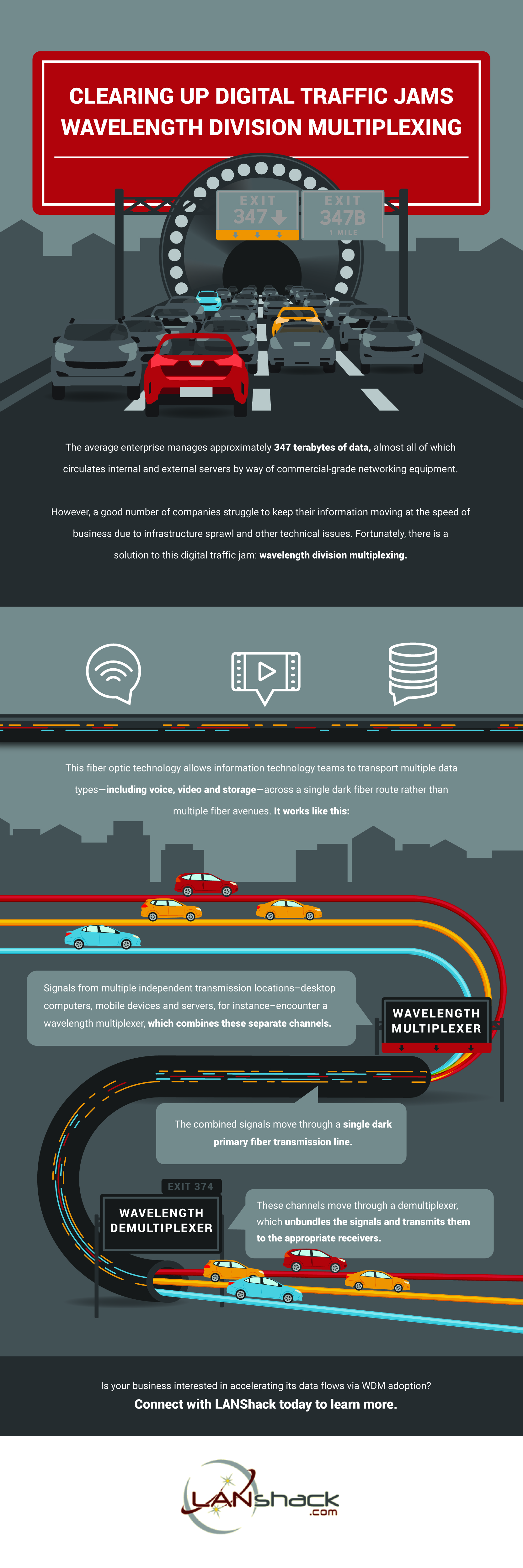
This recent innovation shares a theoretical foundation with OM5 cabling. However, the execution differs considerably. Wavelength-division multiplexing involves integrating multiple signals via laser beams positioned at several wavelengths, according to TechTarget. This process unfolds within the infrared wavelength segment of the electromagnetic spectrum, allowing adopters to harness multiple IR channels per fiber to drastically bolster bandwidth. For instance, some WDM solutions, which include external demultiplexers, support transmission speeds as high as 700 gbps.
Networking innovators began developing WDM technology in the early 1980s, according to the Fiber Optic Association. This allowed telecommunication companies with access to single-mode fiber assemblies to separate 1300 and 1550 nanometer wavelengths with fused couplers. During the later part of the decade, networking hardware providers released fiber optic repeaters, which gave WDM systems the power to create four separate signals in wavelengths within the 1520 and 1560 range. Modern WDM solutions can support up to 32 channels of wavelengths, facilitating as many as 18 channels per fiber.
These capabilities make it easier and less expensive for enterprises to increase their networking bandwidth. Instead of installing additional fiber optic cables or pushing up system bit rates, IT teams can implement WDM systems and maximize their current equipment while maintaining existing networking configurations. These solutions work with many industry-standard inputs, including synchronous optical network and gigabit Ethernet variations.
At the moment, WDM products are primarily used for submarine cables and fiber cabling solutions in which all fibers are engaged. WDM enhances the bandwidth of the former without necessitating extra fibers and extends the lifespan of the latter, unlocking the full potential of these cables even as the decline.
However, these applications are by no means the end-all be-all of WDM. Networking specialists are envisioning an immediate future in which implementers can leverage this technique in conjunction with all-optical networks to facilitate connective installations that can switch optical signals without electronic conversion, or increase or decrease signal volume without manual intervention from administrators. Responsive networks of this kind would render powerful results for scalable, data-dependent enterprises of all sizes.
Both OM5 cabling and WDM systems constitute the future of enterprise networking, facilitating advanced information transmission capabilities fit for the modern age. Organizations interested in expanding their connective infrastructure would be wise to keep an eye on these innovations and consider adopting current iterations in an effort to get a jump on less forward-thinking competitors.
Here at LANShack, we help businesses of all sizes navigate the enterprise networking marketplace and pinpoint innovative solutions that meet their specific operational needs. We specialize in pre-terminated fiber optic assemblies designed to support businesses of all sizes, in every industry. Contact us today to learn how we've been helping enterprises stay connected for more than 20 years.
Sources:
https://www.bicsi.org/uploadedfiles/PDFs/Presentations/Region_Events/dubai_17/Alfred_Tharwat.pdf
http://www.thefoa.org/tech/dwdm.htm
https://www.commscope.com/Blog/The-Future-of-Multimode-Has-a-Name-OM5/