








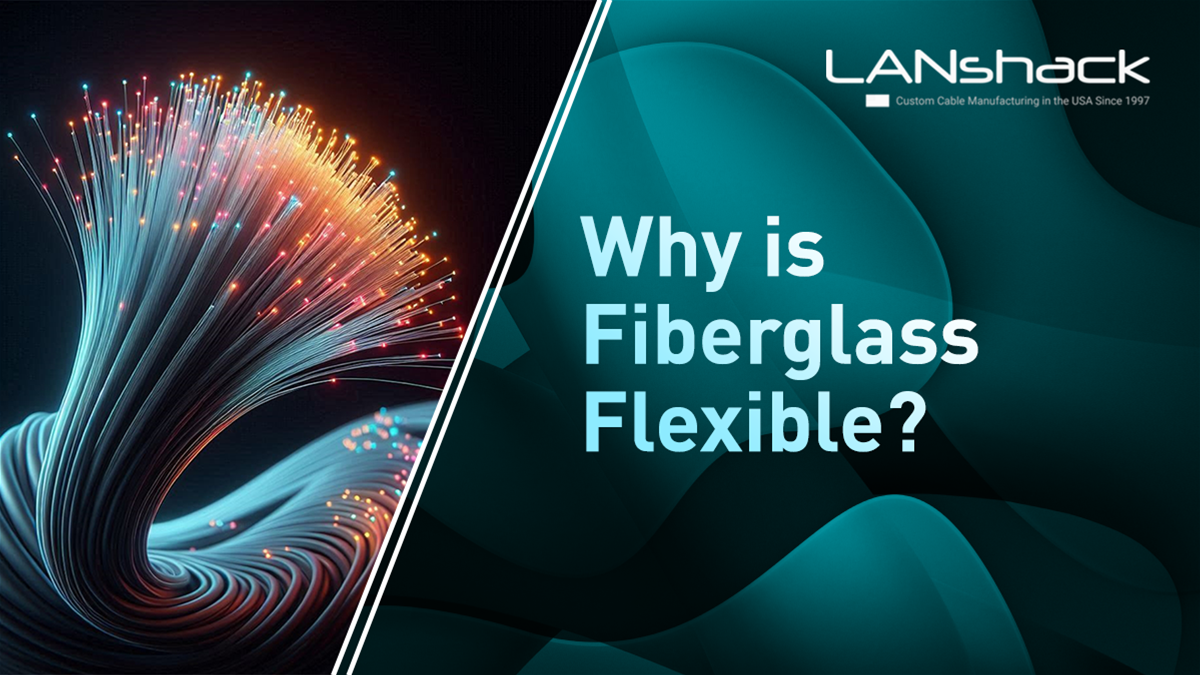


Fiber optic cabling is a modern marvel. Many people know that fiber strands are made of glass, but they might not know how this glass stays intact, transfers data, and is able to bend.
We’ve covered bend radius in another article, but in this one we want to discuss more about why fiberglass is flexible to begin with.
The flexibility of glass in fiber optics results from the combination of its amorphous structure, high purity, small diameter, and the advanced manufacturing processes.
The Material Composition of Fiberglass makes it Flexible:
Fiber glass is made from highly pure silica (SiO2) which reduces the presence of impurities that could cause brittleness.
The glass is also often doped with various materials (like germanium or phosphorus) to modify its refractive index and mechanical properties, enhancing flexibility.
Featured Products
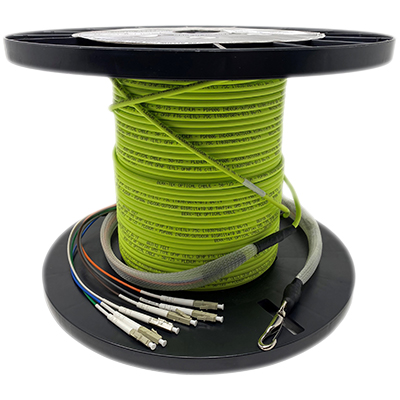
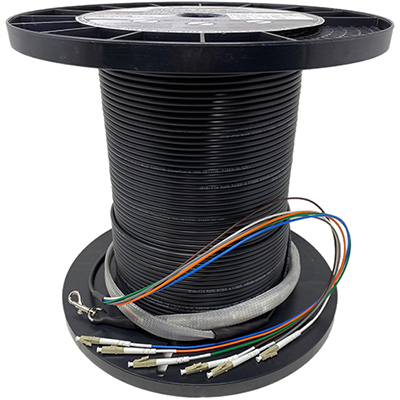
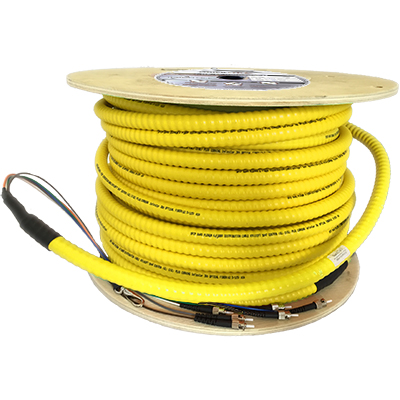
Fiber glass has an amorphous structure, meaning it has no organizational structure and when looked at under a microscope, it would look more like a liquid.
This makes fiber very unique, but also allows the atoms to move more freely, giving the flexible structure we observe as light bends through the glass.
Optical fibers have an extremely small diameter (typically around 125 micrometers for the cladding and 8-10 micrometers for the core), which makes them less susceptible to cracking compared to thicker glass.
Manufacturing strengthens the fiber glass to make it more flexible
During manufacturing, the glass is heated to a high temperature and drawn out into thin fibers.
This process aligns the molecular structure in a way that enhances flexibility.
These fibers are next coated with protective materials like acrylate or polyimide, which provide additional flexibility and protection from environmental damage.
Despite being thin, optical fibers have high tensile strength from this manufacturing process and material composition, allowing them to bend to a high radius without breaking. Each type of fiber strand has its own unique bend radius and you’ll want to refer to the spec sheet to make sure you adhere to it.
If you were to accidentally bend the fiber strand too much, possibly during a tight installation, the fiber may suffer from excessive bending losses or physical damage, which would degrade or possibly completely hinder your data transfer.
So while you have a much higher range before the fiber glass can break, know that it’s not completely indestructible and there is a limit.
Other Notes that improve flexibility of fiberglass
Fiber optic cables are very strong on their own, but manufacturers also take other steps to help take this strength even further.
A buffer coating is applied to help protect the fiber from microbends and environmental damage.
There are also strength members, like aramid yarn (kevlar) that are used in the cable to help give additional strength and flexibility.
The outer jacket of the cable additionally helps as it is made from PVC or polyethylene to give more protection.
All of these characteristics help fiber optic cables to be installed in regular and harsh environments without easily breaking.
That being said, always plan ahead for your installations to be able to swap out fiber optic cabling more easily so you don’t have to completely rewire your entire installation. This can be achieved by including more strands in your assembly to easily swap or to have easy pulling fiber via conduit that you can very easily get to the broken members.
All of these characteristics and properties help make optical fibers versatile and reliable for a wide range of applications.