











What is a BiDirectional SFP Module?
Bidirectional (BiDi) transmission involves using a single fiber core rather than the two used in traditional SFP modules.
BiDi SFP modules achieve this bidirectional transmission by using two wavelengths: one to transmit data and one to receive data. For example, a pair might use 1310 nm for transmission and 1550 nm for reception, or vice versa.
BiDi SFPs should always be used in pairs with varying wavelengths.
These wavelengths travel in opposite directions, allowing data to be sent and received simultaneously. During installation, ensure one module is configured for upstream wavelengths and the other for downstream wavelengths.
A BiDi network can support up to 10G speeds at distances of up to 80 km. For higher data transfer needs, QSFP+ setups may be used. BiDi SFPs are commonly found in data centers and other high-density installations. Recently, 400 and 800 Gig QSFP modules have been added to our store.
Some common examples of BiDi SFP modules include
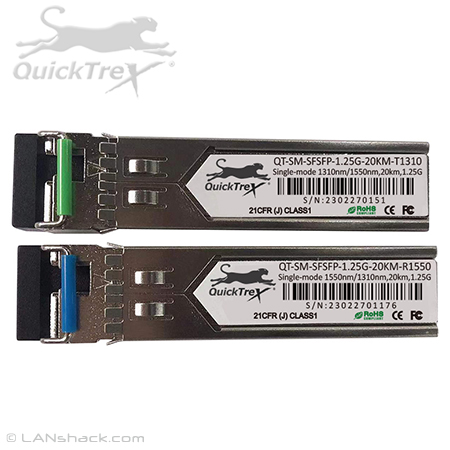
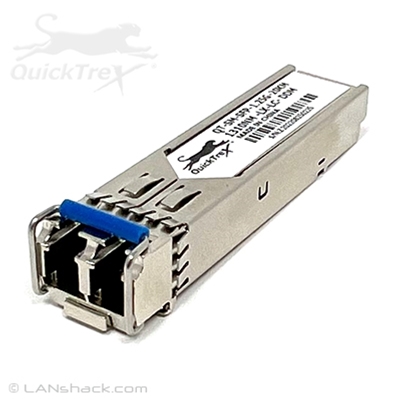
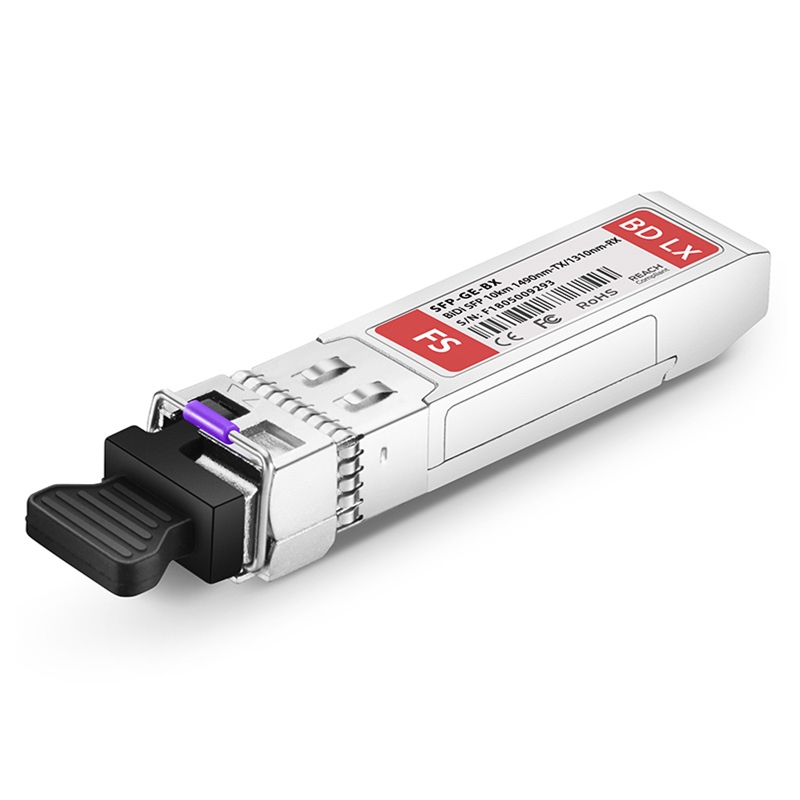
Cisco GLC-BX-D and GLC-BX-U
What are SFP modules used for?
Small Form-Factor Pluggable (SFP) modules are compact, swappable modules that facilitate high-speed data communications over long distances.
They are often used to connect fiber cables to network switches. SFP modules have both a transmitting and receiving side and can be plugged directly into a networking device.
For shorter distances, you could use a 1000BASE-T SFP, which has an RJ-45 connector. Longer distances might utilize other modules like the 1000BASE-LX SFP, which can reach up to 10 km using a single-mode connection.
What’s inside an SFP Module?
In one of our recent TikTok videos, we showed the inside of an SFP module.
Inside of an SFP module you have your laser to transmit the signal, and you have a photo detector to receive the signal. When turned on. You can see the laser being transmitted.
How to Use Bi-Directional SFP Modules
Simply plug one of the SFP modules into the first media converter. This one will be receiving at a 15/5 nanometer wavelength.
Next, plug the other SFP module into the other end of the media converter. This will use 1310 nanometer to transmit.
On this converter we have the internet connection coming in and this is what we're looking to extend.
Simply plug in your LC single mode simplex patch cable into the transceiver.
Then on the opposiute end, where you're extending your network to, plug in the other end of the LC patch cable.
You should now see it is receiving.
Finally, we plug in our ethernet patch cable to see that it is now transmitting and receiving at the same time and that we have a gigabit connection.
Why and When might an installer use BiDi SFPs?
Using BiDi SFPs allows for a more efficient networking and cabling infrastructure, especially in installation spaces with limited room for running fiber.
BiDi SFPs are essential in optimizing fiber usage in environments such as data centers, enterprise networks, and telecom applications.