








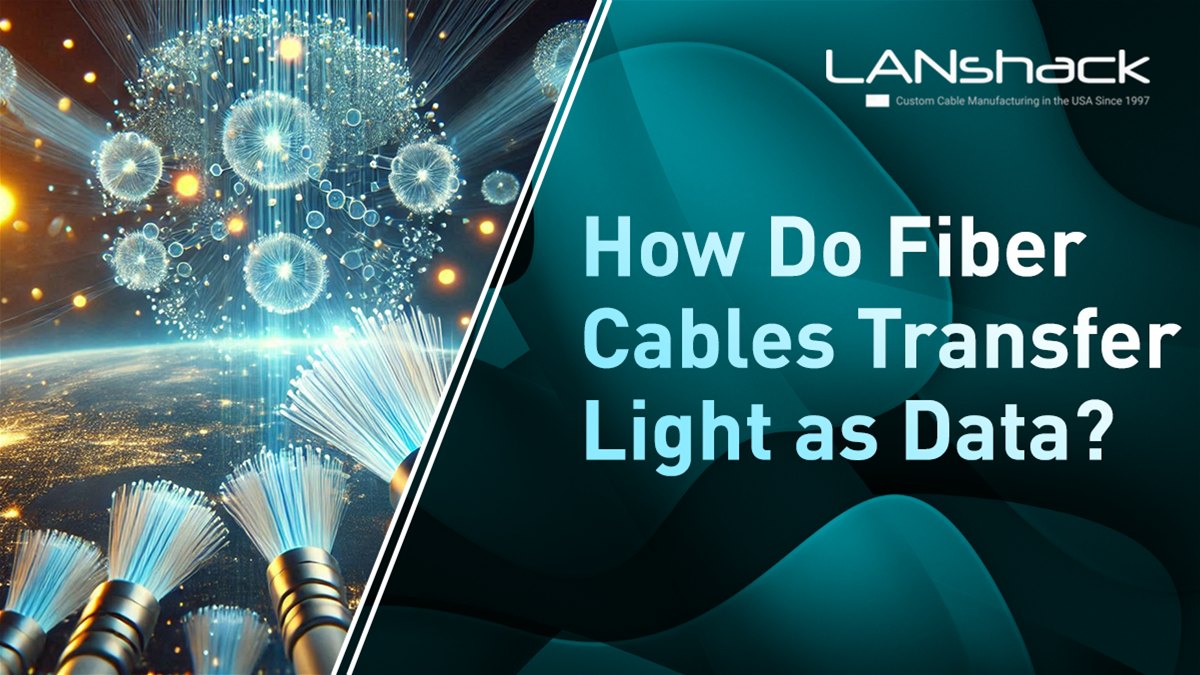


Fiber optic technology is often taken for granted. Do you know how or why light transferring from one end of a small tube to another makes the world run better? Most people don’t.
In this blog, we’ll explore how light travels through fiber optic cables, what makes it possible, and why this technology is so impressive.
We’ll also share videos that showcase these fascinating principles in action.
What Is Fiber Optic Cabling?
At its core, fiber optic cabling uses extremely thin strands of glass to transmit data using light wavelengths.
These strands are so small that they’re comparable in size to a single human hair. Despite their small size, they can carry an incredible amount of information at lightning speeds.
But how does this happen? Let’s break it down step by step.
How Do Fiber Optics Work Step by Step?
Step 1: Converting Data into Light
Fiber optic communication starts with a device (like a router or transmitter) that converts electronic data into pulses of light. This light is usually generated by a laser or LED source.
Step 2: Light Travels Through the Core
The pulses of light are sent into the fiber optic cable's core. The cladding wrapped around the core reflects the light back inward, preventing it from escaping and keeping the signal on its path.
Step 3: Signal Integrity Over Distance
Fiber optic cables can carry light signals over long distances without significant loss of quality. Repeaters can be used along the way to boost the signal if necessary, ensuring data integrity.
Step 4: Converting Light Back into Data
At the receiving end, the light pulses are converted back into electronic signals, which devices like computers or phones can understand.
This process happens so quickly and efficiently that it enables real-time data transfer for everything from streaming videos to powering entire data centers.
Featured Products
How Does Light Travel Through Fiber Optic Cables?
Fiber optic cables are designed to carry light pulses through thin strands of glass — each about the diameter of a human hair. These pulses are essentially data in the form of light wavelengths, which are measured in nanometers (nm).
Key Components That Keep Light Focused:
-
Core: The central glass strand where the light pulses travel.
-
Cladding: A protective layer wrapped around the core. It keeps the light focused and contained within the core, ensuring the light signals travel in a consistent and direct path.
This concept can be seen in action with a simple analogy: shining light through water.
Water, like glass, can act as a medium that focuses and directs light. In this video, we demonstrate how light behaves when passed through water.
As the light source moves closer, the beam becomes more focused and clear — similar to how the cladding in a fiber optic cable keeps light signals on course.
Seeing Fiber Optic Light Transfer in Action in an MTP
Cable
It’s pretty cool to see how light moves through fiber optic cables. MTP connectors, for instance, can house up to 12 strands of fiber. This allows data to transfer at a higher rate because you have more modes of transportation of light.
Check out what they look like when a strand is lit up here.
When you shine a light into one end of a fiber optic strand, you can clearly see the light appear on the other end. This simple visual demonstration highlights how efficiently fiber optics transfer light signals over long distances.
The principle may look straightforward, but behind the scenes, fiber optic cables rely on advanced science to ensure data travels quickly and without interruption.
Where Do Fiber Optics Get Their Signal From?
Fiber optic cables rely on light sources like lasers or LEDs to send signals. The choice of light source depends on the type of fiber optic cable and the distance the signal needs to travel:
-
LEDs are often used for shorter distances, as they provide a lower-cost solution.
-
Lasers are used for longer distances because they produce a more focused and powerful beam of light.
The light source creates pulses that represent binary data (1s and 0s), the foundation of all digital communication.
These pulses then travel through the fiber optic strands at near-light speeds.
Why Fiber Optics Matter
Fiber optics are the backbone of modern communication, enabling technologies that power the internet, phone calls, and data networks worldwide. With their ability to transfer light as data, fiber optic cables:
-
Increase speed: Fiber optics support high bandwidth and fast transfer rates.
-
Reduce interference: Unlike copper cables, fiber optics are immune to electromagnetic interference.
-
Enable long-distance communication: Signals can travel miles without significant loss.
From massive data centers to the cables connecting your home internet, fiber optics ensure the world runs smoothly and efficiently.
Final Thoughts
Understanding how fiber optics work gives us a deeper appreciation for the technology that keeps us connected. From tiny glass strands to massive data transfers, the science of light traveling through fiber is both fascinating and essential to modern life.
If you’re curious to learn more, check out the videos above for real-life demonstrations of these principles in action. Fiber optics may be invisible to most of us, but their impact is seen everywhere.