SALES & ORDERS


Custom Cable Manufacturing in the USA Since 1997



Data center operations demand network infrastructure that delivers maximum bandwidth density while supporting rapid deployment, easy management, and seamless scalability to meet ever-growing capacity requirements. Fiber optic networks provide essential capabilities for modern data center operations:
Modern data centers must support massive bandwidth demands from cloud computing, artificial intelligence, machine learning, and big data applications. Applications routinely require 25G, 100G, 400G, and emerging 800G connectivity with roadmaps to even higher speeds. Fiber infrastructure provides the bandwidth capacity and upgrade path needed to support these demanding applications.
Data center real estate is extremely valuable, requiring maximum utilization of rack space and floor area. High-density fiber connectivity solutions like MTP/MPO systems can support 12-144 fibers in a single connector, enabling dramatically higher port densities compared to traditional copper or single-fiber solutions while reducing cable congestion and improving airflow.
Financial trading, gaming, real-time analytics, and other latency-sensitive applications require network infrastructure that minimizes signal propagation delays. Fiber optic cables provide lower latency than copper alternatives and maintain consistent performance characteristics regardless of electromagnetic interference or temperature variations.
Data centers consume enormous amounts of power, with cooling representing a significant operational expense. Fiber optic infrastructure generates no heat and requires no power for signal transmission, reducing overall facility power consumption and cooling requirements compared to active copper solutions while supporting longer transmission distances.
Modern servers and storage systems require high-speed connectivity to support virtualization, containerization, and software-defined infrastructure. These connections must provide consistent performance and support rapid provisioning and reconfiguration. Critical applications include:
Top-of-rack switch connections supporting 25G/100G server uplinks
Storage area network (SAN) connectivity for high-performance storage systems
Hyper-converged infrastructure networks integrating compute and storage
GPU cluster connectivity for AI/ML workloads requiring ultra-low latency
Modern data center networks utilize spine-leaf architectures that require massive numbers of high-speed interconnections between switching tiers. These networks must support east-west traffic patterns and provide consistent performance regardless of endpoint locations. Key deployments include:
Leaf-to-spine uplinks supporting 100G/400G aggregate bandwidth
Inter-switch links (ISL) providing redundant pathways and load balancing
Data center interconnect (DCI) links connecting multiple facilities
Campus network connections linking data center buildings
Cloud service providers and hyperscale operators require network infrastructure that can scale rapidly while maintaining cost efficiency and operational simplicity. These deployments often involve thousands of connections and automated provisioning systems. Applications include:
Massive-scale server farm connectivity supporting millions of virtual machines
Content delivery network (CDN) infrastructure for global content distribution
Edge computing nodes requiring flexible and scalable connectivity
Multi-tenant cloud infrastructure with secure traffic isolation
Colocation facilities and managed service providers must offer flexible connectivity options to support diverse customer requirements while maintaining operational efficiency and service quality. These environments require standardized solutions that support rapid customer onboarding. Examples include:
Customer cross-connect services providing flexible bandwidth options
Meet-me-room connectivity supporting carrier and provider interconnections
Private cloud and hybrid infrastructure networks
Disaster recovery and business continuity network services
Data centers must follow structured cabling standards including TIA-942 for data center infrastructure design, ensuring proper cable management, documentation, and future scalability. Proper planning prevents cable congestion and maintains organized infrastructure that supports efficient operations and troubleshooting.
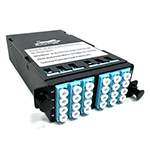
Modern data centers require connectivity solutions that maximize port density while maintaining performance and manageability. MTP/MPO fiber systems, high-density patch panels, and advanced cable management systems are essential for achieving optimal space utilization and operational efficiency.
Data center environments must maintain precise temperature and humidity control while monitoring for potential issues like water leaks, power failures, and security breaches. Network infrastructure must support comprehensive monitoring systems and environmental sensors throughout the facility.
Network infrastructure planning must coordinate with power distribution and cooling systems to ensure adequate capacity and redundancy. Cable routing must consider thermal management and maintain proper separation between power and data cables to prevent interference.
Data center operators typically plan infrastructure investments as part of comprehensive capital expenditure programs that may span multiple years. These investments often involve significant upfront costs but provide long-term operational benefits and support business growth objectives.
Network infrastructure investments are often evaluated based on their ability to reduce ongoing operational costs including power consumption, cooling requirements, and maintenance overhead. Solutions that improve operational efficiency can provide substantial long-term savings.
Data center infrastructure investments must support current requirements while providing upgrade paths for future technologies and capacity expansion. Solutions that support multiple generations of equipment and standards provide better long-term value and investment protection.
Colocation and managed service providers must ensure their infrastructure can support stringent customer SLA requirements including uptime guarantees, performance commitments, and rapid issue resolution. Infrastructure reliability directly impacts business reputation and customer retention.
Yes, we provide solutions supporting current and emerging data center standards including 25G/100G/400G Ethernet, with roadmap support for 800G and beyond. Our MTP/MPO systems support the latest polarity and connector standards required for modern data center deployments.
Absolutely. Our high-density fiber solutions including MTP/MPO systems can support 12-144 fibers per connector, dramatically reducing cable congestion and improving space utilization compared to traditional connectivity methods while maintaining performance and reliability.
We provide comprehensive testing and quality assurance for all products, with consistent performance specifications across entire product lines. Our solutions support automated testing and documentation systems that ensure deployment quality and ongoing performance monitoring.
Fiber infrastructure provides significant advantages for data center power efficiency since it generates no heat and requires no power for signal transmission. This reduces overall facility power consumption and cooling requirements while supporting longer transmission distances than copper alternatives.
Yes, our solutions are designed for efficient installation and support automated provisioning systems. Pre-terminated fiber assemblies, modular connectivity systems, and comprehensive documentation support rapid deployment while maintaining quality and performance standards.
Our solutions support secure multi-tenant deployments with proper isolation and flexible connectivity options. We provide labeling, documentation, and cable management systems that support complex multi-customer environments while maintaining security and operational efficiency.
Our fiber infrastructure provides excellent future-proofing capabilities, supporting multiple generations of equipment and emerging standards. Structured cabling investments made today can typically support several generations of active equipment upgrades without requiring infrastructure replacement.