

|
|
|
|
|
|
|
|
|
|
|
|
|
|
|
|
|
|
|
|
|
|
|
Fast Lead Times/ Fast Shipping
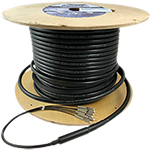
888-568-1230OM3 50/125 Direct Burial Armored Fiber Optic Assemblies are engineered for rugged, permanent outdoor installations that demand durability, protection, and high performance. Built with Corning Altos® cable, these pre-terminated assemblies offer superior crush resistance, waterproof protection, and rodent-resistant shielding. They are ideal for environments where conduit installation is impractical, significantly reducing labor and material costs.
Each assembly features a heavy-duty polyethylene (PE) jacket, corrugated steel armor, and water-blocking swellable tape to ensure reliable signal transmission in harsh outdoor conditions. With options from 2 to 24 strands, these cables support a wide range of data, voice, video, and imaging applications. Whether trenching, securing to a building, or lashing overhead, these assemblies provide the durability and bandwidth necessary for high-performance fiber networks in outdoor settings.
|
PRO-CA-OSPDB-OM4-2
4-5 Business Days |
|
|
|
PRO-CA-OSPDB-OM4-4
4-5 Business Days |
|
|
|
PRO-CA-OSPDB-OM4-6
4-5 Business Days |
|
|
|
PRO-CA-OSPDB-OM4-8
4-5 Business Days |
|
|
|
PRO-CA-OSPDB-OM4-10
4-5 Business Days |
|
|
|
PRO-CA-OSPDB-OM4-12
4-5 Business Days |
|
here’s a closer look at the different strand options and configurations available in our OM3 50/125 Direct Burial Armored Assemblies. These categories provide varying fiber strand counts to meet the specific needs of your installation, from small-scale to large-scale outdoor projects.
This 2-strand assembly is ideal for smaller, high-performance outdoor networks, such as point-to-point connections or remote installations that require minimal fiber usage while still ensuring rugged protection against the elements.
The 4-strand assembly offers a balance between capacity and space efficiency, suitable for small to medium-sized networks that need resilience and flexibility for outdoor use, including campus backbones and building-to-building connections.
Perfect for slightly more complex installations, the 6-strand assembly is ideal for voice, data, video, and image applications requiring higher bandwidth and greater network redundancy in outdoor environments.
For networks that demand higher capacity, the 8-strand assembly provides expanded bandwidth options, perfect for medium to large outdoor fiber networks, including multi-building campus connections.
The 10-strand assembly is well-suited for large enterprise networks or high-traffic outdoor areas, offering ample fiber capacity for expanding data transmission needs while ensuring robust protection.
The 12-strand assembly provides a high level of fiber density and is ideal for complex installations where high capacity and long-term durability are required, including backbones or centralized network systems.
With 18 strands, this assembly supports large-scale fiber networks that demand high capacity and future-proofing, ideal for data centers, telecommunications infrastructure, and broadband applications.
The 24-strand assembly is perfect for large fiber networks requiring significant bandwidth and redundancy, supporting high-density connections in complex industrial or campus installations.
Industries That Might Need OM3 50/125 Direct Burial Armored AssembliesSeveral industries can benefit from the rugged and reliable performance of the OM3 50/125 Direct Burial Armored Assemblies. These industries include:
Telecommunications: For backbone networks that require long-lasting, outdoor solutions.
Data Centers: Offering robust, high-capacity connections to support high-speed data transmission.
Construction & Infrastructure: To provide reliable fiber connections between buildings and structures.
Military & Defense: For secure, durable connections in outdoor, exposed environments.
Utilities & Energy: To ensure consistent communications in remote and rugged locations.
Common Uses for OM3 50/125 Direct Burial Armored AssembliesThese direct burial armored assemblies are designed for a range of outdoor applications, such as:
Campus Backbone Networks: Connecting multiple buildings across large campuses.
Intra-building Backbones: Ensuring high-speed fiber connections between departments or floors within a building.
Industrial & Utility Networks: Providing resilient, high-capacity connections in exposed environments.
Data & Telecommunications: Connecting data centers, cell towers, and remote locations requiring rugged and secure installations.