










Introduction
Hybrid network design is no longer optional for enterprises operating across mixed environments. Data centers, campuses, manufacturing floors, and edge locations rarely operate on a single medium. Instead, they depend on a combination of fiber optics for backbone performance and Ethernet for flexibility and endpoint connectivity.
The challenge is not simply connecting fiber and Ethernet. The real challenge is designing a system that is scalable, cost efficient, low latency, and operationally predictable under load.
This blueprint breaks down how to design a hybrid network that performs reliably under enterprise conditions while remaining adaptable for future growth.
What is Hybrid Network Design and When Should You Use It?
A hybrid network works best when fiber is used for performance critical paths and Ethernet is used for flexible access layer connectivity.
A hybrid network combines fiber optic infrastructure with copper based Ethernet systems to balance performance and cost. In real deployments, I do not treat this as a mix of technologies but as a decision framework based on workload, distance, and scalability requirements.
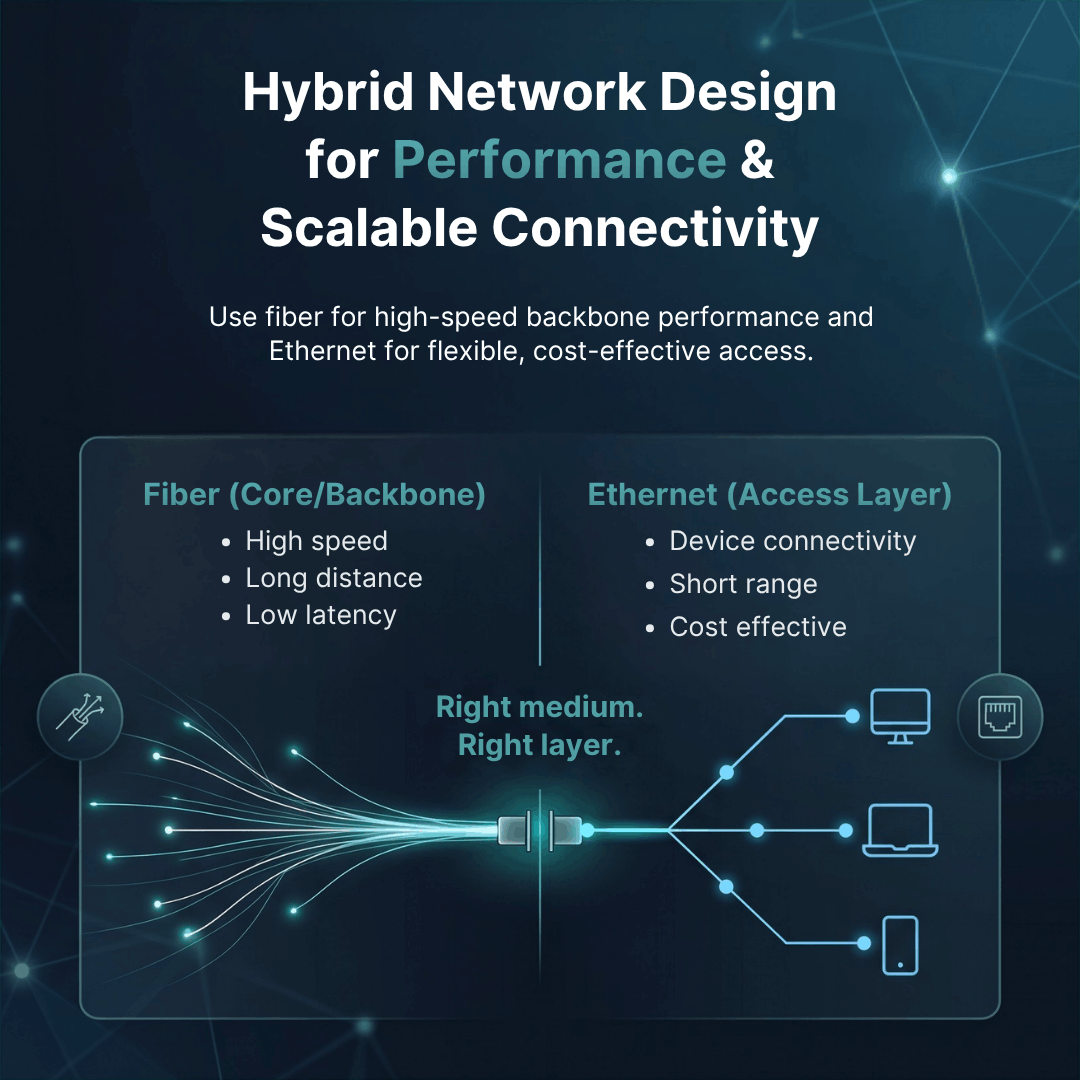
Fiber is typically used for:
- Core and aggregation layers
- Long distance transmission
- High bandwidth requirements
- Low latency critical paths
Ethernet is typically used for:
- Access layer connectivity
- End user devices
- Short distance structured cabling
- Cost sensitive deployments
The goal is not mixing technologies randomly. It is assigning each medium to the layer where it delivers the highest efficiency.
Fiber vs Ethernet in Hybrid Networks
One of the most common questions I get is when to use fiber and when Ethernet is enough.
In practice, I use fiber where performance, distance, and reliability are critical. This includes backbone links, inter building connectivity, and high throughput aggregation layers.
I rely on Ethernet where flexibility and cost efficiency matter more than raw performance. This includes access layer deployments, endpoint connectivity, and environments where frequent changes are expected.
A simple rule I follow:
- Use fiber when bandwidth demand or distance becomes a constraint
- Use Ethernet when device density and cost efficiency are the priority
Problems usually occur when organizations try to push Ethernet beyond its limits or overuse fiber where it adds no real value.
In my experience, organizations see the most value from hybrid design when they stop thinking in terms of technology preference and start thinking in terms of workload requirements.
When Hybrid Network Design Becomes Necessary in Real Environments
Hybrid architecture becomes essential in scenarios where a pure fiber or pure Ethernet approach creates limitations.
Typical triggers include:
- Multi building campuses with centralized data centers
- Data center to edge or branch connectivity
- High bandwidth backbone with moderate access layer demand
- Gradual migration from legacy copper networks to fiber
- Cost constraints that prevent full fiber deployment
If your network must handle both high throughput and high device density without excessive cost, hybrid design is the correct approach.
In practical deployments, I usually recommend hybrid architecture when scaling pressure starts impacting either performance or cost in a single medium setup.
Core Principles I Follow When Designing Hybrid Networks
When designing hybrid networks, I focus on balancing performance, scalability, and operational simplicity rather than over engineering a single layer.
1. Layered Architecture Discipline
A hybrid network must strictly follow a layered model:
- Core layer: high speed fiber switching
- Distribution layer: aggregation using fiber with controlled breakout
- Access layer: Ethernet connectivity for endpoints
Avoid collapsing layers unless you are working with small scale deployments. In my experience, early shortcuts here create long term bottlenecks.
2. Fiber as Backbone, Not Everywhere
One mistake I see repeatedly is over deploying fiber. Fiber should dominate backbone paths but not necessarily extend to every endpoint.
Use fiber for:
- Inter building links
- Data center spine leaf fabrics
- High density aggregation switches
Use Ethernet for:
- Office endpoints
- IoT and devices
- Workstations and printers
3. Predictable Bandwidth Allocation
Do not assume theoretical bandwidth. I always validate design decisions against real traffic patterns.
Example:
- Core fiber links at 40G or 100G
- Distribution uplinks at 10G to 25G
- Access layer at 1G or 2.5G per port
A 3:1 or 5:1 over-subscription ratio at the access layer works in most enterprise environments, but this should always be validated.
4. Structured Breakout Strategy
Breakout is where hybrid design often fails in real environments.
You must define early:
- Where fiber transitions to Ethernet
- Whether you use MTP to LC breakout or switch level conversion
- How many endpoints each fiber trunk supports
- Unplanned breakout leads to congestion, poor cable management, and troubleshooting complexity. I have seen this become a major issue during scaling phases. In most cases I have seen, breakout issues only surface after scaling, which makes them more expensive to fix.
Hybrid Network Architecture Models and When to Use Them
Choosing the right architecture model depends on scale, application requirements, and how traffic flows across your environment.
Model 1: Campus Hybrid Network
Best for universities, hospitals, and enterprise campuses.
Structure:
- Core: fiber ring or spine
- Distribution: fiber uplinks to building switches
- Access: Ethernet to endpoints
Key advantage: centralized control with scalable expansion. I recommend this model when managing multiple buildings with shared infrastructure.
Model 2: Data Center Hybrid Fabric
Used in modern application driven environments.
Structure:
- Spine switches interconnected via fiber
- Leaf switches connected via fiber
- Servers connected via Ethernet or DAC
Key advantage: low latency east west traffic with flexible server connectivity. This is typically the preferred approach in modern application environments.
Model 3: Gradual Migration Model
Ideal for legacy networks moving toward fiber.
Structure:
- Existing Ethernet access remains
- Fiber introduced in backbone
- Incremental replacement of copper over time
Key advantage: controlled cost and minimal disruption. I often suggest this approach for organizations transitioning from legacy systems.
Key Components I Prioritize in Hybrid Network Design
1. High Density Fiber Trunks
MTP or MPO cables allow multiple fiber strands in a single connector. These are essential for backbone efficiency.
Design consideration:
- Choose 12 or 24 fiber configurations based on growth planning
- Avoid underutilized fiber capacity. I usually plan capacity with future expansion in mind rather than current usage only.
2. Breakout Modules and Cassettes
These convert high density fiber into usable connections such as LC.
Use cases:
- Connecting fiber trunks to switches
- Transitioning between layers
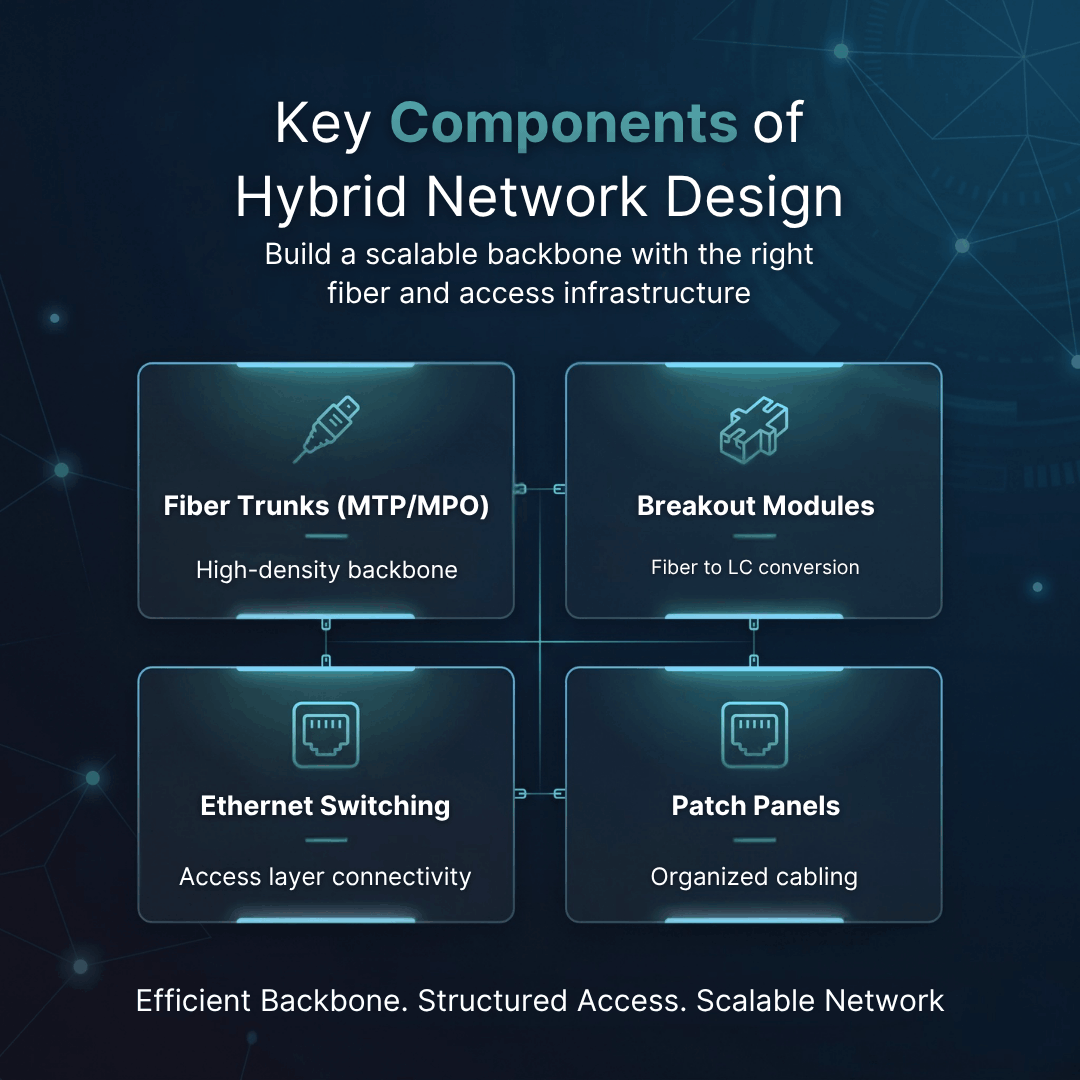
3. Ethernet Switching Layer
Access switches must support:
- Required port density
- Power Over Ethernet (PoE) if required
- Uplink capacity aligned with fiber backbone
4. Patch Panels and Cable Management
Hybrid networks fail operationally when physical infrastructure is ignored.
Ensure:
- Clear labeling
- Logical cable routing
- Separation of fiber and copper pathways
How I Optimize Performance in Hybrid Networks
Performance optimization in hybrid networks is primarily about minimizing unnecessary conversions and maintaining predictable traffic flow.
Latency Control
Fiber ensures low latency, but poor design can negate benefits.
Avoid:
- Excessive conversions between fiber and Ethernet
- Long patching chains
Keep critical paths fiber dominant. In performance critical environments, this decision alone can significantly reduce latency issues.
Redundancy Planning
Hybrid networks must account for failure scenarios.
Implement:
- Dual fiber paths in core
- Redundant switches at distribution
- Link aggregation for fail-over
Scalability Strategy
Do not design for current load only.
Plan for:
- Port expansion
- Additional fiber trunks
- Higher speed upgrades such as 10G to 40G or 100G
Common Mistakes I See in Hybrid Network Design
Most hybrid network issues are not caused by technology limitations but by poor planning decisions made early in the design phase.
Overengineering the Access Layer
Not every endpoint needs fiber. This increases cost without meaningful performance gain. I often see budgets wasted here instead of strengthening the backbone.
Ignoring Breakout Planning
Unplanned breakout leads to:
- Port shortages
- Cable clutter
- Increased troubleshooting time
This usually becomes visible only when scaling begins.
Mismatched Speeds across Layers
Example:
100G core with 1G uplinks creates bottlenecks
Always align speeds logically across layers. This is one of the most overlooked issues in enterprise deployments.
Lack of Documentation
Hybrid networks are harder to manage.
Without documentation:
- Troubleshooting time increases
- Scaling becomes risky
In my experience, documentation is often treated as optional, but it directly impacts long term network stability.
FAQs
Q1: What is a hybrid network design?
A hybrid network combines fiber for backbone performance and Ethernet for access layer flexibility. It balances speed, scalability, and cost.
Q2: When should I use fiber instead of Ethernet?
Use fiber for long distances, high bandwidth, and low latency paths. Ethernet works best for short distance endpoint connectivity.
Q3: How do I decide between MTP and LC in hybrid networks?
MTP is ideal for high density backbone links, while LC is used for device level connections. Breakout planning determines how both are used together.
Q4: What is oversubscription in network design?
Oversubscription is the ratio between access layer demand and uplink capacity. It ensures cost efficiency without overbuilding bandwidth.
Q5: What are common mistakes in hybrid network design?
Common issues include poor breakout planning, speed mismatches across layers, and overuse of fiber in access networks.
Q6: Can hybrid networks scale easily?
Yes, if designed with proper layering and capacity planning. Fiber backbone allows easy upgrades without redesigning the entire network.
Q7: Is hybrid network design suitable for data centers?
Yes, most modern data centers use hybrid models with fiber spine leaf architecture and Ethernet for server connectivity.